How Do You Cool a Garage with Fans?
Here's how to cool a garage with fans: exhaust hot air and draw cooler outdoor air in when outdoor conditions allow. Aim a separate fan across your work area for personal comfort.
On this page (7 sections)
Here's how to cool a garage with fans: push hot air outdoors and let cooler air enter through a separate opening. Add airflow across your work area if you need relief while standing at a bench.
A fan moves air over your skin, but it doesn't refrigerate the room. For the difference between personal comfort and lower air temperature, see whether a fan actually cools a room.
Choose your setup around 2 jobs: replacing warm indoor air and moving air over you. One fan may handle either job, but a fixed workbench often benefits from its own directed airflow.
How do you cool a garage with fans?
Start with cooler replacement air and a clear exit path. Ventilation helps remove stored heat when outdoor air is cooler than the air inside.
Compare indoor and outdoor temperatures before opening everything. Early morning or evening may offer better conditions than the middle of a hot afternoon.
Use this setup sequence:
- Open a door or window on the cooler, shaded side.
- Place a fan near another opening and aim it outdoors.
- Clear boxes and stored items from the route between openings.
- Check that incoming air reaches the occupied part of the garage.
- Add a separate comfort fan if the exhaust setup leaves your bench outside the airflow.
Keep the door into your house closed so the garage doesn't become a path for losing conditioned indoor air.
With only one garage-door opening, use one side for exhaust and leave space elsewhere for incoming air. Avoid filling the opening with the fan and stored items, which restricts the return path.
Should the fan blow into or out of the garage?
Blow outward to remove warm indoor air, provided cooler air can enter elsewhere. Place the intake opening away from the exhaust so fresh air travels through the garage instead of leaving immediately.
An inward-facing fan suits a bench near an opening when the incoming air is cooler. It still needs an exit route, or it mainly stirs the air around that corner.
With a single opening, compare inward and outward placement under similar outdoor conditions. Use a thermometer to judge temperature changes and your work position to judge comfort.
When outside air is hotter, opening more doors may add heat. A fan aimed at you can still provide airflow, but more ventilation isn't automatically better.
Where should you place a fan for garage airflow?
Aim a comfort fan at your body and an exhaust fan toward an opening. Put each on a stable surface with room around its intake and outlet.
For standing work, angle airflow toward your torso rather than letting it pass below the bench. Keep it away from loose papers, sawdust piles, and surfaces where you're applying a finish.
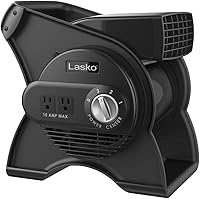
The Lasko 12-inch High Velocity Utility Fan (U12104) suits one-person bench work and tight floor spaces. Its 270-degree pivot helps aim air from a low position, while 3 speeds let you adjust the breeze.
At 7.5 pounds, with a carry handle, it's a practical choice for moving between a bench and another indoor work spot. Its 10-foot cord gives you placement options without putting the fan directly beside the outlet.
The 2 built-in grounded outlets can serve nearby devices within the manual's limits. They don't increase the capacity of the wall circuit.
Skip this compact blower if your main goal is broad airflow across several work positions. It fits targeted comfort better than a plan built around a wide floor fan, and it's intended for indoor use.
Which fan style works for a garage?
Choose the shape and controls around your work area before comparing airflow figures. A compact blower fits a small spot, while a larger floor fan needs a clear parking place where tools and doors won't hit it.
Check the assembled footprint, cord reach, cleaning access, and how often you'll move the fan. Airflow figures alone can't tell you how much air will reach a bench behind shelves.
How do you cool a garage with adjustable airflow?
Choose a fan with fine speed control if you switch between active work and seated tasks. Strong airflow may feel welcome during physical work but disturb paperwork or small parts at the same bench.
The Vornado Model 80X 20-inch High Velocity Fan offers variable control with 99 power levels. Its kickstand adjusts airflow vertically, and Vornado designs it for indoor whole-room circulation.
This is the better fit for a garage that doubles as a hobby room, where you want to tune the breeze rather than choose among a few fixed speeds. Its removable grille also gives you access for routine cleaning.
Skip it if you need a wall-mounted fan or equipment for wet conditions. Its floor-mount design needs a protected position, and its indoor use limits still apply beside an open garage door.
For more on placement, read how an air circulator differs from a fan. Read how to choose a garage or shop fan if you need help narrowing the fan style first.
Which larger fans suit garage cooling?
A tilting floor fan suits an open work zone where you can leave room for a larger frame. Choose between easy relocation, wall placement, and a heavier drum design based on your layout.
The B-Air Firtana 20-inch Garage Floor Fan has 3 speeds, a tilt-adjustable head, a carry handle, and metal housing. B-Air gives its airflow capacity as 4,650 CFM.
Choose it for an open garage where simple controls and occasional relocation matter. Wall mounting is another option, but the wall hanger isn't included; plan the mounting location and suitable support before buying.
Its 5-foot cord makes outlet location worth measuring. Skip it for work that creates heavy airborne dust: the motor is open rather than enclosed, so don't treat the metal housing as protection against workshop debris.
The DEWALT 20-inch Tilting Drum Fan (DXF2042) fits a dedicated floor position in a garage with room around the frame. It has 3 speeds, a 180-degree adjustable head, aluminum blades, and rubber pads beneath its metal construction.
DEWALT gives its maximum airflow as 5,000 CFM and includes motor overheating protection. Choose it for a clear work bay where you can direct air across the occupied area.
At 18.7 pounds, it's less appealing if you carry a fan between locations throughout the day. Measure its assembled footprint and the route around it before choosing it for a crowded garage.
How can you use garage fans safely?
Keep fans stable, dry, and clear of loose debris. Route cords away from tires, closing doors, sharp edges, and walking paths, and follow the manual's electrical and clearance instructions.
Start at a low speed and increase it only as needed. Strong airflow across a dusty floor can spread debris over your tools and work surface instead of improving the work area.
Unplug the fan before cleaning or moving it for maintenance. Remove loose dust from accessible surfaces, and only remove guards or parts as the manual permits.
Check the grille, cord, plug, and base during cleaning. Let cleaned parts dry fully before reassembly, and see how to clean a pedestal fan for general steps that may also apply to guarded floor fans.
Never run a vehicle engine or generator in the garage, even with doors open and fans running. Ordinary portable fans also aren't suitable equipment for clearing flammable paint or solvent vapors.
What mistakes keep a garage hot?
Reduce heat gain and fix blocked airflow before adding another fan. A second fan won't solve a setup that pulls in hotter air or sends incoming air straight back outside.
Common mistakes include:
- Opening up during peak heat: compare outdoor and indoor temperatures first.
- Blocking the intake: leave clearance behind the fan as well as in front.
- Cooling the wrong spot: aim airflow where your body is during work.
- Ignoring sun: shade sun-facing windows where practical.
- Leaving fans running in an empty garage: use them for a clear ventilation goal or when someone needs airflow.
If you're considering insulation or air conditioning, address the roof, walls, door, and air leaks as a whole. Those changes affect heat entering the garage; fans mainly help distribute or exchange the air already available.
For more placement ideas, see what an air circulator fan does.
Which setup should you choose to cool a garage?
Choose by your work position and the available air path. Knowing how to cool a garage starts with deciding whether you need cooler replacement air, a breeze at one bench, or airflow across an open bay.
Pick the Lasko for compact, directed bench comfort. Choose the Vornado for an indoor hobby space where fine speed adjustment matters.
Choose the B-Air for a larger adjustable fan with a wall-mount option. Pick the DEWALT when you have a dedicated floor position and don't need to carry it around often.
If the garage remains too hot, move the work to a cooler place or time. Use the best fans for a garage or shop to compare options after measuring the space where your fan will sit.
Frequently asked questions
How do you cool a garage with fans?
Exhaust warm air through one opening and let cooler outdoor air enter through another; aim a separate fan across your work area for comfort, then reduce heat from direct sun where possible. If outdoor air is hotter, use airflow for personal comfort rather than expecting ventilation to lower the garage temperature.
Should a garage fan blow in or out?
Aim the fan outward when you want to exhaust warm garage air and have another opening for cooler replacement air; an inward-facing fan can bring cooler air toward a bench, but it still needs an exit path. Choose the direction that moves air across the space you use.
Do fans lower the temperature in a garage?
Fans don't lower air temperature by themselves; they can make you feel cooler by moving air over your skin, while ventilation can lower garage temperature when outdoor air is cooler. If the garage stays excessively hot, move the work to a cooler place or time instead of adding more fans.
Where should I place a fan in a garage?
Place an exhaust fan near an opening, with a separate route for incoming air; position a comfort fan where airflow reaches your body without blowing dust across the bench. Keep it stable, leave the intake clear, and route its cord away from foot traffic, doors, and moving equipment.