Air Circulator vs Fan: What Is the Difference? (November 2026)
The air circulator vs fan choice comes down to room circulation or a direct breeze. Choose a circulator to mix air across a space, or an oscillating fan to sweep airflow over people.
On this page (10 sections)
- Air circulator vs fan: what is the difference?
- Which airflow pattern should you choose?
- Which style suits a bedroom, office or living room?
- Which of these models fits your routine?
- How should you set up an air circulator or fan?
- Does an air circulator cool a room better?
- Which controls and electricity costs matter most?
- How do upkeep and cleaning compare?
- What buying and setup mistakes should you avoid?
- Air circulator vs fan: which should you buy?
The air circulator vs fan choice comes down to how you want air to move: through the room or directly across your skin. Choose a circulator to mix air across a space, or a conventional fan to send a steady or sweeping breeze toward people.
An air circulator is a type of fan, so these aren't separate cooling technologies. The useful differences are airflow direction, placement and controls, rather than the name on the box.
Air circulator vs fan: what is the difference?
An air circulator usually sends a focused stream across a room, while a conventional fan often serves a nearby person or seating area. Either can provide a direct breeze when aimed toward you.
A circulator uses that directed stream to stir surrounding air and encourage movement through the space. A tilting head lets you change the route, such as aiming above furniture instead of straight into it.
An oscillating tower or pedestal fan turns side to side to share its breeze. Each person feels airflow as the fan passes, rather than receiving the same steady stream all the time.
The categories overlap, so don't buy on the label alone. A well-placed conventional fan can move room air, and a circulator can work beside a desk.
How should you compare air circulator and fan specifications?
Compare direction, adjustment and usable space first, then speed choices and controls. Those details tell you more about everyday fit than a single maximum airflow figure.
Airflow reach, air speed and CFM describe different things. Reach describes distance, air speed describes how fast air moves, and CFM describes air volume per minute.
Don't rank different models by those numbers as though they were the same measurement. A long reach claim doesn't tell you the room size a fan will serve comfortably or how much breeze reaches your chair.
Which airflow pattern should you choose?
Choose a fixed airflow path for room mixing and an oscillating breeze for people spread across a seating area. For one person who wants constant relief, a stationary fan aimed at the chair may be the simplest option.
Room circulation is useful when one part of a space feels still while another receives air from an air conditioner. It needs an open route, so a large sofa or tall cabinet can matter more than another speed setting.
Oscillation suits several people who want some airflow without a constant draft. Skip it if you dislike the breeze repeatedly arriving and fading, or keep oscillation off when only one seat needs cooling.
For a broader comparison of shapes and controls, use the room fan guide. The guide to what an air circulator fan is and how to use one explains circulation in more detail.
Which style suits a bedroom, office or living room?
Choose by where people sit and where the fan can stand, rather than by room name. Sketch the route between the fan and the places that need airflow before choosing a size.
In a bedroom
Choose a tower fan when you want a sweeping breeze across the bed and convenient controls at night. Choose a circulator when you want to mix room air without keeping the outlet aimed at your pillow.
Check the bed height and any furniture between the fan and mattress. A low fan behind a solid bed frame may need a different position, not a higher speed.
Light-sensitive sleepers should look for a dimming display, while people who change settings after lying down should prioritize a remote. For sound-related choices, see the guide to quiet bedroom fans.
In a home office
Choose a compact circulator if you have a sturdy spare surface and want a steady airflow angle. Skip a desk model when papers, monitors and cables already fill the work area.
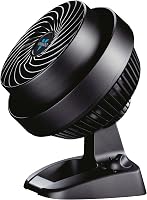
The Vornado 530 measures 8.1 in deep, 9.8 in wide and 10.8 in high. Its 3 manual speeds and adjustable tilt suit a small office where you can set the airflow once and leave it alone.
Keep the stream away from loose paperwork and the microphone during calls. If the fan causes a desk to hum, try a different stable surface before raising its speed.
In a living room
Choose an oscillating fan for people sitting across a sofa or in separate chairs. Choose a circulator when the main goal is moving air along an open room rather than taking turns delivering a breeze.
A dining table, bookcase or sofa back can interrupt the route. Position the fan where air can pass the obstacle instead of placing it wherever an outlet happens to be.
The best oscillating fans for living rooms offer more choices for shared seating. If you need a taller outlet, compare tower fans with pedestal fans.
Which of these models fits your routine?
Choose the Vornado 660 for adjustable room circulation, the DREO for bedroom controls and the Vornado 530 for a smaller surface. Their different shapes matter as much as their airflow features.
The 660 has 4 speeds, top-mounted push-button controls and a 90-degree tilt. Its body occupies an 11.75 x 13.5 in footprint, so reserve a stable spot with room around the intake.
Vornado claims airflow reach up to 100 ft for the 660 and up to 65 ft for the 530. Use those figures as reach claims, not room-size recommendations.
Skip the larger Vornado if every suitable spot is blocked by furniture. The compact model is easier to fit on a spare surface, but its simpler controls suit people who don't need frequent adjustments from across the room.
The DREO stands 41.89 in tall on a 12.72 x 12.72 in footprint. A tower saves space above its base, but it still needs floor space and a clear route to the bed or chair.
Its 9 speeds, 4 modes, remote and 12-hour timer suit people who want more control without getting up. The display dims after 30 seconds, which is useful beside a bed.
Skip the tower format if your only clear spot is a tabletop or you need to aim the stream upward. Choose the fan you can position well, even if another has more settings.
How should you set up an air circulator or fan?
Start with a clear intake, clear outlet and stable base, then adjust the direction from where you'll use it. Position usually deserves attention before speed.
For room circulation, try aiming along the longest open route or slightly upward within the fan's adjustment range. Don't aim straight into the back of a sofa and expect air to pass through it.
The Vornado 660's adjustable body gives you room to change that route. It suits a fixed position where you can aim the stream across the space or above a low obstruction.
For direct cooling, start with the fan facing your seat on a low setting. Increase the distance or change the angle if the breeze dries your eyes or feels too strong.
Turn on oscillation when several seats need airflow, then check the full sweep. Part of that sweep may otherwise end up pointed at a wall while occupied seats get only a brief pass.
Keep cords out of walking paths and leave the clearances required by the manual. Don't balance a fan on books, place it on a soft bed or leave loose curtains near its intake.
Does an air circulator cool a room better?
Neither style lowers room temperature on its own; moving air helps you feel cooler and can spread air cooled by another source. A stronger breeze and a lower thermometer reading are different results.
With an air conditioner, aim the circulator along an open route toward the warmer occupied area. Keep both appliances' intakes and outlets clear so one doesn't obstruct the other.
With windows, ventilation helps when outdoor air is cooler and suitable to bring inside. Opening a window to hotter outdoor air won't turn the fan into an air conditioner.
Closed doors also limit airflow between rooms. If you need comfort in several separate rooms, don't expect one fan in a hallway to serve every space equally.
Fans aren't a replacement for air conditioning during extreme heat; follow the CDC's heat guidance. Read whether a fan actually cools a room for more on air movement and temperature.
Which controls and electricity costs matter most?
Prioritize controls you'll use daily, then compare electricity use for the exact models. Neither the circulator label nor the tower shape guarantees lower running costs.
A manual dial works well when the fan stays at one setting beside your desk. A remote is more useful when furniture makes the controls hard to reach or you adjust airflow from bed.
Timers suit people who want the breeze while falling asleep but don't need it all night. More speed settings can help you find a comfortable step between too weak and too strong.
For electricity use, find the wattage on the appliance or in its manual. Multiply watts by daily hours, divide by 1,000, then multiply by your electricity rate per kilowatt-hour.
The guide to how much electricity a fan uses walks through that calculation. Use figures for the setting you expect to run when they're available, rather than assuming maximum power applies all day.
How do upkeep and cleaning compare?
Choose a fan with cleaning access you can manage, because both styles collect dust along the intake, grille and blades. Narrow openings can make routine dust removal more awkward.
The Vornado 660 has a removable front grille, while the DREO has a removable rear grille. Follow each manual for removal and cleaning instead of assuming every cover comes off the same way.
Unplug the fan before cleaning. Vacuum or brush accessible dust using the methods the manual allows, and never spray cleaner through the grille toward the motor.
Wash only parts the instructions permit you to wash. Let them dry fully before refitting them, and never immerse the powered body.
Check for buildup more often in rooms with pets or heavy dust. Use how to clean a tower fan alongside the model's instructions for a practical cleaning sequence.
What buying and setup mistakes should you avoid?
Avoid buying by maximum speed or reach alone, because neither fixes a blocked airflow path. Measure the intended spot and consider your normal seat before ordering.
- Mistaking height for a tiny footprint: A tower still needs room for its base, cord and full oscillation sweep.
- Choosing room circulation for immediate relief: If you mainly want a breeze at your desk, aim airflow at the desk rather than around the room.
- Choosing direct airflow for every situation: A constant stream at one chair won't necessarily make another seating area comfortable.
- Running the highest speed by default: Move the fan or adjust its angle before accepting more noise and a stronger draft.
- Ignoring daily access: Leave enough space to reach the controls, unplug the cord and clean the grille.
Also check electrical compatibility when buying across borders. Both Vornado models here are built for U.S. voltage requirements, and Vornado limits their stated use and warranty coverage to the U.S.
Air circulator vs fan: which should you buy?
For your final air circulator vs fan decision, choose the model that fits your airflow route and daily routine. Use these rules to narrow the choice:
- Pick the Vornado 660 for a larger living room or office with a clear route for directed circulation.
- Pick the DREO tower for a shared bedroom or seating area where a sweeping breeze and remote adjustments matter.
- Pick the Vornado 530 for a small home office with a spare stable surface and a preference for simple controls.
The DREO's 90-degree oscillation suits people spread across a bed or seating area. Choose a fixed direction when you want the breeze to stay on one spot.
Before buying, mark the base dimensions in the intended spot and trace the airflow route past your furniture. If that route is blocked, change the location or fan shape first.
Compare the best air circulator fans for more room-mixing options, or the best tower fans for more choices with a tall body and convenient controls.
Frequently asked questions
Is an air circulator better than a regular fan?
An air circulator is better suited to mixing air across a room, while a regular fan often suits direct personal cooling. Choose by the airflow path you need: a fixed stream across the space or a breeze over your chair, bed or sofa.
Can an air circulator cool a whole room?
An air circulator can distribute air through a room, but it doesn't lower the air temperature by itself. It can help move cooled air away from an air conditioner and reduce uneven comfort between areas, provided furniture and closed doors don't block the airflow path.
Should an air circulator point at you?
Point an air circulator at you when you want a direct breeze; aim it across the room when you want broader mixing. Start on a low setting and adjust the angle from your normal seat, keeping the intake clear and avoiding an uncomfortable stream at your face.
Can you use an air circulator with an air conditioner?
Yes, an air circulator can help spread cooled air from an air conditioner into occupied parts of the room. Keep the air conditioner's intake and outlet clear, then aim the circulator along an open route toward the area that feels warmer; adjust its position before increasing speed.