DREO 28ft/s Tower Fan Review: Worth It? (November 2026)
The 9-speed DREO tower fan suits bedrooms and shared living spaces where you want remote control, several airflow settings and easy access for cleaning. Choose the smart DREO for app and voice control, Levoit for vertical aiming, or Lasko for adjustable height.
On this page (9 sections)
- The DREO 28ft/s tower fan at a glance
- What do the DREO fan's speed and airflow numbers mean?
- Does the DREO 28ft/s tower fan work for sleep?
- How does it compare with the smart DREO?
- When are Levoit or Lasko better choices?
- How should you set up and position the DREO?
- How should you clean and care for the DREO?
- Which buying mistakes should you avoid?
- Which DREO tower fan should you buy?
The 9-speed DREO tower fan is a good choice for bedrooms and living rooms where you want direct control over the breeze, a remote and accessible cleaning. Choose a different model if your main need is app control, vertical aiming or adjustable height.
Its appeal is the mix of everyday controls rather than one headline airflow number. You can change the breeze for reading, working or sleeping without buying a connected fan.
FancyFolder compared the controls, airflow features and maintenance access of this DREO with the smart DREO, Levoit and Lasko alternatives below.
The DREO 28ft/s tower fan at a glance
The main DREO combines 9 speeds and 4 modes with a remote and a removable rear grille. It suits someone who wants to choose the airflow directly and keep routine cleaning manageable.
DREO 28ft/s Tower Fan, 9 Speeds: Best for shared living rooms

- 9 speeds
- 1473 CFM airflow
- 90° oscillation
- Removable rear grille
Choose this DREO for a shared room where different seats need a breeze and you want close control over fan speed. The removable rear grille also makes routine dust removal easier.
Pros
- 9 speeds and 4 modes
- 90° oscillation
- 12-hour timer and automatic display dimming
- Removable rear grille
Cons
- No app or voice control
- Fixed height and no vertical angle adjustment
- Base needs clear floor space
Standard, Natural, Sleep and Turbo modes cover different uses, but start with Standard to find a comfortable steady speed. That gives you a useful baseline before you try the other modes.
The tower measures 41.89 inches tall, with a 12.72-inch square base, and weighs 9.8 lb. Measure the base area as well as the height, especially if it will sit between a bed and nightstand.
Who should choose this DREO tower fan?
Choose it for manual control in a shared room, particularly if one person wants a light breeze and another prefers stronger airflow. The range of settings gives you several adjustment points without requiring a phone.
Skip it if you want the fan to change speed automatically with room temperature. The smart DREO, Levoit and Lasko offer that function.
Also look elsewhere if furniture blocks the airflow at its fixed height. Increasing speed won't solve a breeze aimed into the side of a mattress or the back of a sofa.
What do the DREO fan's speed and airflow numbers mean?
The DREO's 1473 CFM airflow capacity describes air volume, while its claimed speed of up to 28 ft/s describes how fast air moves. Use those figures to understand the fan's intended output, then choose around placement and controls.
DREO claims airflow reach of up to 36 ft. Treat that as a reach claim, not a room-size recommendation, since doors, furniture and the fan's position affect the breeze you receive.
A strong stream aimed at one chair can feel very different from air spread across several seats. For solo use, a fixed direction may be more useful than oscillation.
For a shared sofa or two nearby work areas, the 90° sweep helps share the breeze. Each person receives airflow for part of the sweep rather than a constant stream.
Don't choose between models based on a tiny difference in CFM. The DREO and Levoit figures are nearly identical, so their aiming options and controls are more useful deciding factors.
For more alternatives, compare the picks in our best tower fans guide. Our guide to tower fan height, speed and noise explains how those choices affect placement.
Does the DREO 28ft/s tower fan work for sleep?
The DREO is a sensible bedroom choice if you want automatic display dimming and a scheduled shutoff. Its display dims after 30 seconds, and the timer runs up to 12 hours.
Dimming is different from a fully dark display, so consider your tolerance for light when choosing its position. Keep the controls within reach while avoiding a direct view of the display from your pillow.
DREO describes its DC motor as quiet, but there is no sound figure here for a direct comparison. Choose the lowest speed that keeps you comfortable rather than expecting the strongest setting to suit sleep.
Start with a steady speed before trying Sleep mode. If changing airflow bothers you, a fixed manual setting may suit you better than a mode that varies the breeze.
Aim the fan across your body rather than straight into your face if direct airflow feels drying. Position it while lying down, since a breeze that reaches you while sitting up may miss you at pillow height.
Our best tower fans for bedrooms guide covers other bedroom choices. If sound matters most, use the quiet fan guide for bedrooms to narrow the options.
How does it compare with the smart DREO?
Choose the smart DREO for app access, voice commands and temperature-based speed changes. Choose the main DREO if a remote and manual settings cover your needs.
| Feature | DREO 9-speed | DREO Smart |
|---|---|---|
| Speed settings | 9 | 8 |
| Modes | Standard, Natural, Sleep, Turbo | Normal, Natural, Sleep, Auto |
| Timer | 12 hours | 8 hours |
| Controls | Remote | App, remote, touch and voice |
| Temperature-based Auto mode | No | Yes |
| Cleaning access | Removable rear grille | Removable rear grille and impeller wheel |
The smart version has a 36.22-inch body and an 11.81-inch square footprint. Its shorter shape may fit more easily beside low furniture, but check that the outlet can still send air where you need it.
Its airflow capacity is 978 CFM, and DREO claims the same maximum air speed as the main model. That illustrates why maximum speed alone is a poor way to choose between fans.
Auto mode is useful when room temperature changes during the day and you don't want to keep reaching for the controls. It adjusts fan speed, rather than cooling the room to a set temperature.
The removable impeller wheel gives the smart model another access point for cleaning. Follow its own instructions for removal and reassembly instead of assuming both DREO models come apart the same way.
Skip the smart version if you prefer a steady breeze and rarely use connected controls. The main model already includes a remote, so you don't need app features simply to change settings from the sofa.
When are Levoit or Lasko better choices?
Choose Levoit for vertical aiming or Lasko for adjustable outlet height. These features solve placement problems that extra speed settings cannot fix.
Levoit for aiming above or below a fixed outlet
The Levoit adds 30° of vertical angle adjustment alongside horizontal oscillation. That makes it worth considering when the fan can sit in a suitable floor spot but needs to aim higher toward a chair or bed.
Levoit 1472 CFM Tower Fan: Best for raised seating

- 1472 CFM airflow
- 5 speeds
- 90° horizontal oscillation
- 30° vertical angle adjustment
Choose Levoit when you need to aim the breeze higher or lower without moving the fan. Its vertical adjustment helps match airflow to your seating position.
Pros
- 30° vertical angle adjustment
- 90° horizontal oscillation
- Auto mode adjusts speed to room temperature
- Advanced Sleep mode turns off display and sound
Cons
- Fewer speed choices than either DREO
- Advanced Sleep mode changes speed and starts oscillation automatically
Its 5 speeds offer fewer adjustment steps than either DREO. Choose it if directing the breeze matters more than having a larger menu of speeds.
Levoit states sound levels as low as 22 dB, which should not be read as the sound at every setting. Its Advanced Sleep mode turns off the display and sound after 5 seconds.
That mode also begins oscillating after an hour and changes speed as conditions change. Skip it if you want the fan to hold one direction all night, or use a manual mode instead.
Our DREO vs Levoit tower fan comparison helps if these are your final two brands.
Lasko for reaching a taller bed or seat
The Lasko Elevation adjusts from 42 to 54 inches, making it the better fit when a fixed tower sits too low. Measure your mattress or seating height before deciding how much adjustment you need.
Lasko Elevation DC Tower Fan (EST100): Best for tall beds
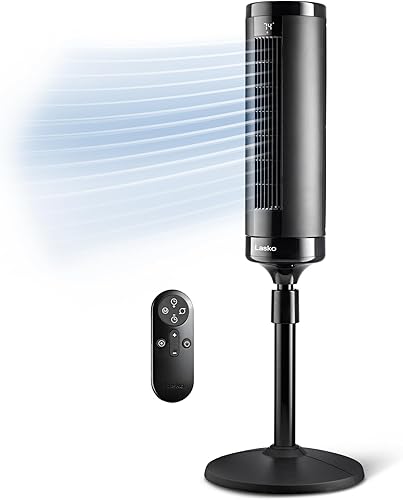
- Adjustable height up to 54 in
- 8 speeds
- 90° oscillation
- Remote control
Choose Lasko when a fixed-height tower would send the breeze below your mattress or seating. Its adjustable stand gives you more control over the outlet's height.
Pros
- Adjustable height up to 54 in
- 8 speeds and 4 wind modes
- AirSense adjusts speed as room temperatures change
- 12-hour timer
Cons
- 14.62 in square footprint needs floor space
- 13 lb weight matters if you move it often
Its 14.62-inch square footprint needs a clear floor area, and its 13 lb weight matters if you plan to carry it between rooms. Skip it for a tight bedside gap where the stand would crowd your walking path.
Lasko's AirSense adjusts speed as room temperature changes. The brand also claims air speeds up to 40 ft/s and reach up to 60 ft, but height adjustment is the clearest reason to choose it here.
If adjustable height is your main requirement, our tower fan vs pedestal fan guide can help you decide which shape better suits the room.
How should you set up and position the DREO?
Set the DREO on a level floor with a clear path to your seat or bed. Assemble and secure the base according to the manual before switching it on.
DREO describes setup as tool-free. Check that the base sections are seated correctly and the fasteners are secure, since a loose base can allow movement or rattling.
Follow the manual's clearance guidance rather than placing the intake against a wall or curtain. Leave enough room for oscillation without the body touching furniture.
Check the cord route before settling on a spot. Keep it out of walkways and avoid trapping it beneath furniture.
Start with oscillation off and aim the outlet toward the area you use most. Choose a comfortable speed, then enable oscillation if another seat also needs airflow.
Avoid placing the fan directly behind a sofa and trying to push air through it. Move the fan beside the obstruction or choose a model with suitable height or aiming adjustment.
Keep the fan on the floor rather than balancing it on furniture to gain height. If the outlet is too low, that is a reason to choose a different fan.
How should you clean and care for the DREO?
Unplug the fan before cleaning, and use the removable rear grille for routine dust removal. DREO allows vacuuming or rinsing the grille.
Keep water away from the motor, controls and electrical parts. A washable grille does not mean the whole fan body can be rinsed.
Let the grille dry completely before reattaching it, and make sure it is secured before reconnecting power. Use the manual to identify which parts you can remove.
Check the intake regularly if the fan sits near pet hair, bedding or a dusty floor. Clean when dust builds up rather than waiting for the airflow to weaken.
Before storing the fan, clean it and let every cleaned part dry. Store it somewhere dry where the cord will not be crushed.
For a full routine, see how to clean a tower fan. If it becomes louder or starts rattling, our guide to why a tower fan gets loud covers common causes to check.
Which buying mistakes should you avoid?
Avoid buying around maximum speed alone. The right airflow direction and a comfortable everyday setting matter more than a top speed you rarely use.
- Expecting refrigeration: These fans move room air; they do not produce chilled air.
- Measuring only the tower body: Allow room for the base, clearance and a safe cord route.
- Assuming Auto means a thermostat: Automatic speed changes cannot hold a room at an air-conditioning set point.
- Confusing height with aim: A taller fan raises the outlet, while vertical adjustment changes its direction.
- Choosing modes you won't use: A steady manual setting may suit you better than changing airflow.
- Ignoring furniture: A clear path to your body is more useful than extra power aimed into an obstacle.
For one person at a desk, start by solving placement and direct airflow. For a shared room, consider how the sweep reaches each seat and whether everyone wants a breeze at the same time.
Which DREO tower fan should you buy?
Choose the 9-speed DREO tower fan for direct control, the smart DREO for connected controls and automatic speed changes, Levoit for vertical aiming, or Lasko for a taller outlet. Let the feature that solves your room's main problem decide.
Before ordering, mark out the base area and check the airflow path from that spot to your usual seat or pillow. This simple measurement can rule out a poor fit before speed and mode counts distract you.
If your goal is to lower the room's actual temperature, a fan needs to work alongside another cooling or ventilation plan. Read does a fan actually cool a room? to decide where it fits.
Frequently asked questions
Is the DREO 28ft/s tower fan worth considering?
The 9-speed DREO tower fan is worth considering for bedrooms and shared living spaces where remote control and easy cleaning matter; choose it for manual airflow control and a scheduled shutoff. Choose the smart version instead if you want temperature-based speed changes, app access or voice commands.
How tall is the DREO 28ft/s tower fan?
The DREO 28ft/s tower fan measures 41.89 inches tall, with a base measuring 12.72 inches deep and wide; measure the floor space and nearby furniture before buying. Check that the airflow path can reach your chair or bed, and follow the manual's clearance guidance during setup.
Can you clean the DREO 28ft/s tower fan?
The DREO 28ft/s model has a removable rear grille for cleaning; DREO allows vacuuming or rinsing that grille, but unplug the fan before removing it. Keep water away from the motor, controls and electrical parts, and let the grille dry completely before putting it back.
Does the DREO 28ft/s tower fan cool a room?
The fan helps you feel cooler by moving air across your skin, but it doesn't lower room temperature on its own; use it where people can feel the breeze rather than leaving it running in an empty room. Our guide explains whether a fan cools a room in more detail.


