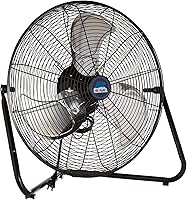
How Does a Box Fan Work?
A box fan works by spinning a set of angled blades inside a square housing, which pulls room air in through the back grille and pushes it out the front as a straight stream. The motor turns the blades, the blade pitch creates the moving air, and the air's speed is what makes you feel cooler.
On this page (9 sections)
- What are the parts inside a box fan?
- How does a box fan move air?
- Why does moving air feel cool on your skin?
- What do the speed controls change?
- How much electricity does a box fan use?
- Why is a box fan's airflow different from a circulator's?
- Where should you place a box fan for the best result?
- How do you clean and maintain a box fan?
- Which box fan should you pick?
A box fan works by spinning angled blades inside a square frame, pulling room air in through the back grille and pushing it out the front as a straight stream. The motor turns the blades, the blade angle moves the air, and that airflow cools you, not the room.
The basic idea is simple, but the details decide how well a fan works in a bedroom, a workshop or a stuffy living room. This guide covers the parts, the airflow, the controls and the practical limits of how a box fan works.
What are the parts inside a box fan?
A box fan is a motor, a set of blades and a square housing with a back grille and a front grille. The motor sits at the center, the blades turn around a hub, and the two grilles keep hands and objects away from the moving parts.
The motor is the only part that uses electricity. A brushless motor, like the one in the Vornado Model 80X, uses magnets to keep the rotor spinning with less friction than an older brushed design.
The blades attach to the motor shaft and turn as one unit. The housing does more than hold the fan together, since its square shape lets the fan sit flush in a window or against a wall.
The grille pattern shapes how the air leaves the fan, and a removable grille makes cleaning the blades easier.
How does a box fan move air?
A spinning blade works like a set of moving wedges that scoop air and throw it forward. Each blade is angled so its leading edge cuts into the air and its trailing edge pushes that air toward the front of the fan.
As the blades turn, they create a low-pressure zone behind the fan. Room air flows into that gap through the back grille to replace what's being pushed out, so the fan keeps feeding itself as long as it runs.
The result is a steady stream of air leaving the front. Box fans are axial fans, which means air travels straight through along the axis of the blades, so the stream is broad and direct rather than wide and swirling.
For the same reason, a box fan loses push quickly once you move a few feet away from it.
Why does moving air feel cool on your skin?
Moving air feels cool because it speeds up sweat evaporation and blows away the warm, damp layer of air your body creates. Your skin constantly releases moisture, and still air traps it close to you.
A fan's stream replaces that trapped layer with drier room air. As sweat evaporates, it pulls heat from your skin, so you feel cooler even when the air temperature hasn't changed.
This is why a fan pointed at you feels good on a muggy evening.
The effect works best when the air is dry. In very humid weather, sweat evaporates more slowly, so the breeze helps less.
If you want the full picture of what a fan can and can't do to a room, our guide to whether a fan actually cools a room explains the difference between cooling people and cooling air.
What do the speed controls change?
Speed controls change how fast the motor turns the blades, and faster blades move more air per second. A fan with more speed settings gives you finer control over noise and airflow.
The Vornado Model 80X has 99 power levels on its touch controls, which lets you dial in a very gentle breeze or a strong stream. The Vornado 660 uses 4 speeds with push buttons on top, and the Vornado VORA 8 offers 10 speeds with touch controls and a remote.
Higher speeds do three things at once: they move more air, make more noise and draw more electricity. Most people run a box fan at a low or middle setting for sleeping and turn it up when a room needs a quick air change.
The timer on some models, like the 12-hour timer on the VORA 8, shuts the fan off so it doesn't run all night at full power.
How much electricity does a box fan use?
A box fan uses very little power compared with air conditioning, and the cost depends on the speed setting and how long it runs. A small motor turning a light blade set draws far less than a compressor.
Electricity use rises with speed. Running a fan on high for hours costs more than a low setting for the same time, and a fan left on all day adds up over a month.
Our guide to how much electricity a fan uses breaks down the numbers by fan type and run time.
A brushless motor helps here because it wastes less energy as heat. A timer or auto shut-off also cuts use, since the fan stops when you don't need it.
If your goal is a cooler room rather than a cooler you, remember that no fan lowers the thermostat reading.
Why is a box fan's airflow different from a circulator's?
A box fan pushes a broad, straight stream in one direction, while an air circulator throws air farther and stirs the whole room. The difference comes from blade depth, grille design and how the housing shapes the exhaust.
A circulator like the Vornado 660 uses deep-pitched blades, an inlet guide cone and a spiral grille to move air up to 100 ft. That distance lets it mix warm and cool air across a large room instead of just cooling whoever sits in front of it.
The Vornado VORA 8 adds multi-axis oscillation so the stream sweeps in more than one direction.
Box fans still win on price and simplicity for spot cooling. If you're comparing designs and wondering how a bladeless fan works, that model pulls air through a slit and multiplies it, with no visible blades at all.
Each design trades reach, noise and cost differently.
Where should you place a box fan for the best result?
Placement decides most of a box fan's usefulness. Point the fan at yourself for comfort, or use it to push air out of a window to pull fresh air in.
For personal cooling, set the fan a few feet away and aim the stream at your body. A kickstand or tilt feature, like the built-in kickstand on the Model 80X, lets you angle the airflow up toward a bed or sofa.
Keep the fan on a stable floor and away from curtains that could get sucked into the back grille.
For ventilation, face the fan outward in an open window so it blows stale air out. That creates a pressure difference that draws fresh air in through other openings.
A second fan in another window can speed the exchange, but don't expect a box fan to cool a sealed room; it only moves the air that's already there.
How do you clean and maintain a box fan?
Unplug the fan, remove the grille if it's removable, and wipe the blades and housing with a damp cloth. Dust on the blades throws the fan off balance and cuts airflow over time.
The Model 80X has a removable grille that makes cleaning easier. Let all parts dry fully before reassembling and plugging the fan back in.
For a tower-style fan, the steps differ, and our guide to how to clean a tower fan covers that design.
Check the cord for cracks and keep the fan away from water. Store it upright when the season ends, and cover it to keep dust off the motor vents.
A clean fan runs quieter, moves more air and lasts longer.
Which box fan should you pick?
Pick the Vornado Model 80X if you want a large box fan with fine speed control and a timer, since its 99 levels and built-in timer suit bedrooms and living rooms. Its 20-inch frame and kickstand make it easy to aim at a bed or a chair.
Pick the Vornado 660 if whole-room air mixing matters more than a straight blast. Pick the VORA 8 for a smaller room where you want a remote and multi-axis airflow.
Now that you know how a box fan works, match the design to the job: spot cooling for one person, or circulation for the whole space.
Frequently asked questions
Does a box fan make the room colder?
No, a box fan doesn't lower the air temperature. It moves air across your skin so you lose heat faster and feel cooler.
The room warms slightly from the motor, so use the fan to cool people, not to chill the space.
Why does a box fan feel cool if the air isn't chilled?
Moving air speeds up sweat evaporation and strips away the thin layer of warmed air your body creates. That's why you feel a breeze even when the thermometer stays put.
Step out of the stream and the cooling effect stops.
What do the speed settings change on a box fan?
Speed settings change how fast the blades spin. Higher speeds move more air and feel stronger but use more electricity and make more noise.
Lower speeds are quieter and better for sleeping, while the top setting suits big rooms and quick air changes.
Can I run a box fan all day?
Yes, most box fans are built for continuous use, though long runs add up on your power bill. A brushless motor and a timer help keep energy use down.
Unplug it before cleaning, and keep it away from water and curtains.
What's the difference between a box fan and an air circulator?
A box fan pushes a broad, straight stream in one direction. An air circulator uses a deeper blade and a shaped grille to throw air farther and stir the whole room.
The circulator moves air around; the box fan mostly cools what's directly in front of it.